

Piano Relocation Services Vancouver
Need piano relocation services in Vancouver? Always Best Moving plans the whole job before a caster leaves the floor: a route survey at both addresses, the elevator booking, the strata paperwork, the street staging, and a crew carrying the piano dolly, skid board, straps, and blankets the instrument actually needs. We work out of 422 Richards Street downtown, hold a 4.9-star record across 102 reviews, and give you a clear, no-obligation quote agreed up front and put in writing before we start. Call 236-885-7710 and the plan starts today.
Free moving quote
The Route Survey: Where Every Piano Relocation Starts
Weight comes first, because weight sets everything else. A spinet runs 200-400 lbs. A console goes 350-450 lbs, a studio upright 400-500 lbs, and a full upright 500-800 lbs. A baby grand sits around 500-600 lbs, and a concert grand can hit 900-1,200 lbs. Anything over 500 lbs needs professional movers and the right gear: a piano dolly, a skid board, straps, and moving blankets that keep the piano locked in place during transit. Weight class decides crew size, and crew size decides the gear that rides along. So we pin it down before we quote it.
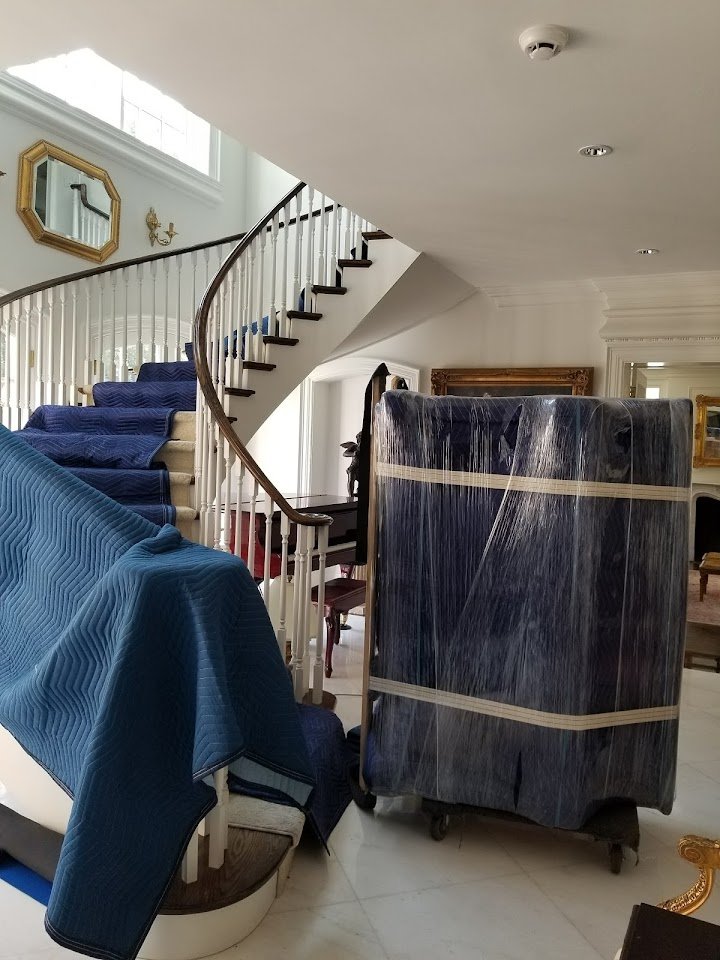
Then the route. Before move day we look at both addresses: door widths, stair turns, hallway corners, elevator dimensions, and where the truck sits at each end. A grand that rides the freight elevator flat on a skid board is a different job than an upright coming down a narrow walk-up staircase. When the route is on paper, the day runs on schedule. No guesswork, no improvising in a stairwell.
Building Rules, Permits, and Street Staging
Vancouver condos and towers run on strata rules, and a piano tests them harder than any sofa. The elevator has to be booked at least 7 to 14 days ahead, and 3 to 4 weeks out is the safe window for a planned relocation. Most buildings charge a non-refundable move fee of $50 to $300 plus a refundable damage deposit of $200 to $500. Many also want the mover’s certificate of insurance, naming the strata as Additional Insured, in their hands 48 to 72 hours before the move. We file the certificate of insurance your strata or building requires. Break a rule and the fines run up to $200 per infraction. We handle all of it as part of the plan.
Move hours are boxed in too. Outside downtown the common weekday window is 7 AM to 8 PM, with different windows downtown, so we schedule inside the lines. On the street, a truck parked in front of a residential or commercial property can’t sit more than 3 hours between 8 AM and 6 PM without a permit. If your block is metered or reserved, the City issues a temporary special zone permit ahead of the move; the engineering line is 604-871-6730, and the City’s reserved-space page covers the details. Those fees belong to the building and the City, not to us. We flag every one early so you can budget for it.
Our Piano Relocation Services
The bread and butter of Vancouver piano work. The instrument gets wrapped in blankets, strapped to a piano dolly, and walked out on a route the crew already knows. Spinets at 200-400 lbs and consoles at 350-450 lbs move with a tight two-man rhythm. Full uprights at 500-800 lbs get a bigger crew, because the survey told us so before the truck rolled.
Upright and spinet relocations
The bread and butter of Vancouver piano work. The instrument gets wrapped in blankets, strapped to a piano dolly, and walked out on a route the crew already knows. Spinets at 200-400 lbs and consoles at 350-450 lbs move with a tight two-man rhythm. Full uprights at 500-800 lbs get a bigger crew, because the survey told us so before the truck rolled.
Grand and baby grand relocations
Grands don’t travel on their legs. We take the legs, pedals, and music desk off, wrap every piece, and ride the body on its side on a skid board with straps holding it square. At 500-600 lbs for a baby grand and up to 900-1,200 lbs for a concert grand, this is exactly the class of instrument that needs professionals, not favours from friends. Reassembly happens at the destination, level and tight, before we leave.
School, venue, and church moves
Institutions relocate pianos on calendars, not whims. Vancouver takes its piano life seriously; the Vancouver Academy of Music at 1270 Chestnut Street in Vanier Park has been running since 1969 and stages over fifty concerts a year. That’s the kind of schedule a planned relocation has to respect. Whether it’s a school gym, a sanctuary stage, or a recital hall, we survey the loading route, book the timing around your program, and land the instrument ready for the next rehearsal.
Climate-safe holds between addresses
Possession dates don’t always line up, and a piano is the worst thing to park in a random garage. Steinway’s care guidance calls for a constant temperature around 20 C with humidity between 45% and 70%, so an unheated locker in January is a soundboard problem waiting to happen. When there’s a gap between homes, we hold the piano through our storage service and deliver the day you have keys.
Ferry runs and Vancouver Island relocations
Island moves are still planned moves, just with a sailing in the middle. BC Ferries treats any vehicle over 7 feet tall as over-height, which covers a piano-move cube truck, and extra length over 20 feet is charged per foot. We build the sailing into the day’s schedule and show the ferry fare as its own third-party line in the written breakdown. No terminal surprises.
Placement and tuning-ready delivery
Where the piano lands matters as much as how it got there. It shouldn’t sit near a window, an outside door, a radiator, or any other heat source. We place it in the right spot the first time, level it, and reassemble everything. Then the instrument settles, and your tuner brings the pitch back to A-440, because changes in pitch can make the tuning unstable after any move.
Built for a Vancouver move
One plan for the whole job
Survey, paperwork, elevator booking, street staging, the move, and the placement come from one crew on one written plan. If the piano is part of a full household move, our local moving crew runs the same day, and our packing services box the rest of the house around it.
The paperwork gets done
Certificate of insurance filed 48 to 72 hours ahead. Elevator locked in 3 to 4 weeks out. Street permit sorted with the City when the block needs one. You never stand in a lobby arguing with a building manager while the truck idles.
Real piano gear on every truck
Piano dolly, skid board, straps, and thick moving blankets, plus runners and door protection for the buildings at both ends. Pianos over 500 lbs simply can’t move safely without this kit, so it rides on every piano job by default.
A quote in writing and a 4.9-star record
You get a clear, no-obligation quote agreed up front and put in writing before we start, covering the crew, the truck, and the piano gear. Behind that sit 102 reviews averaging 4.9 stars on Vancouver moves. A piano is the most expensive single item most households own. Pick the mover people actually vouch for.
What Piano Relocation Costs in Vancouver
One honest story. You get a clear, no-obligation quote agreed up front and put in writing before we start, and it covers the crew, the truck, and the piano gear: the dolly, the skid board, the straps, the blankets. Before anything moves, that written quote lays out every step of the plan, from survey to placement. If a number isn’t in the written plan, you don’t pay it. That’s what the survey is for. The weight class, the stairs, the elevator timing, and the distance between doors and truck all shape the job, and we look at every one of them before we put a number on paper.
Then there are the third-party costs, and we name them early instead of letting them ambush you. A strata move fee runs $50 to $300 and a refundable damage deposit $200 to $500, both set by your building. A metered block needs a temporary special zone permit from the City. An Island run adds a ferry fare, with over-height and per-foot length charges set by BC Ferries. None of those are our fees. All of them go in the plan, so the budget you approve is the budget you pay.
- Free, no-obligation quote up front
- The breakdown in writing before we start
- No mystery number over the phone, no surprise at the tailgate
A 4.9-star record across 102 reviews
“Excellent service and very good pricing! I would highly recommend them to anyone looking for a moving company in Vancouver.”
“Recently hired this business. They responded quickly & professionally. Service was on time. Handled with care. Highly recommend. Will be repeat customer if needed. Thank you Always Best Moving.”
“Very helpful, friendly and were able to deliver a very heavy awkward piece for us. Pricing was very competitive and would use them again. Thanks!”
Frequently asked questions
How much does a piano weigh?
It depends on the type. A spinet runs 200-400 lbs, a console 350-450 lbs, a studio upright 400-500 lbs, and a full upright 500-800 lbs. A baby grand sits around 500-600 lbs, and a concert grand can hit 900-1,200 lbs. We confirm the class during the route survey so the right crew and gear show up.
Do I need professional movers for a piano relocation?
For anything heavy, yes. Pianos over 500 lbs need professional movers and the right gear: a piano dolly, a skid board, straps, and moving blankets that keep the piano in place during transit. Stairs, tight halls, and elevators raise the stakes fast. That’s the job we’re built for.
How far ahead should I book a piano relocation in a Vancouver condo?
Book 3 to 4 weeks out. Vancouver strata buildings expect the elevator reserved at least 7 to 14 days ahead, and 3 to 4 weeks is the safe window for a planned move. We handle the booking with your building as part of the plan.
What paperwork does my building need from the mover?
Usually a certificate of insurance, naming the strata as Additional Insured and filed 48 to 72 hours before the move. We file the certificate of insurance your strata or building requires, so your piano isn’t stuck in the lobby over a form.
Will my piano need tuning after the relocation?
Plan on it. Pitch has to hold at A-440, and changes in pitch can make the tuning unstable. A move plus a new room is exactly that kind of change. We place the instrument well, let it settle, and you book your tuner a few weeks after delivery.
Where should the piano sit in the new home?
Away from trouble. A piano shouldn’t sit near a window, an outside door, a radiator, or another heat source. The ideal room holds a constant temperature around 20 C with humidity between 45% and 70%. We place it right the first time so nobody is shoving 700 lbs across hardwood later.
Do you relocate pianos for schools, venues, and churches?
Yes. Institutional moves are scheduled jobs with real deadlines. Vancouver has serious piano institutions, like the Vancouver Academy of Music at 1270 Chestnut Street in Vanier Park, which stages over fifty concerts a year. Recital calendars don’t move, so we build the relocation around your dates, not ours.
Can you move a piano to Vancouver Island?
We do ferry runs. BC Ferries treats any vehicle over 7 feet tall as over-height, which covers a piano-move cube truck, and extra length over 20 feet is charged per foot. We plan the sailing into the schedule and put the ferry fare in your written breakdown as a third-party line, so nothing surprises you at the terminal.
How is a piano relocation priced?
You get a clear, no-obligation quote agreed up front and put in writing before we start. The quote covers the crew, the truck, and the piano gear. Third-party costs, like a strata move fee, a damage deposit, a street permit, or a ferry fare, are set by the building, the City, or BC Ferries, and we flag each one early so you can budget for it.
This city is on the move. Metro Vancouver’s rental vacancy rate hit 3.7% in 2025, up from 1.6% the year before and the highest in over 30 years, and when households change addresses, pianos change addresses with them. A piano is the one thing in the house that can’t ride in a hatchback, and it deserves better than a rushed Saturday.
Tell us the piano, the two addresses, and the date. We run the survey, book the elevator, file the paperwork, and hand you the written quote before anyone lifts a thing. One team, one written plan, an instrument that arrives ready to play. Call us and talk to a person, any hour, any day.
Areas We Serve
Downtown · Yaletown · West End · Coal Harbour · Kitsilano · Mount Pleasant · all Vancouver areas we serve
Other Moving Services
Piano Moving Service · Local Movers · Packing Services · Moving & Storage · Junk Removal
Areas we serve across Vancouver
We load and unload across Vancouver, from Downtown, Gastown and the West End to Mount Pleasant, Strathcona and Olympic Village. See every area we serve.
Want the bigger picture? Browse all our piano moving services.
Ready to book your move?
Get a free quote with the plan and the price agreed before we start.