
Moving Supply Store Vancouver
You can get all your moving supplies in Vancouver from Always Best Moving Vancouver: small, medium, large, dish, and wardrobe boxes, plus tape, packing paper, bubble wrap, and reusable plastic bins, dropped at your door. We are the crew at 422 Richards Street downtown, rated 4.9 stars across 102 reviews, and we match the boxes to your home so you buy what you need and not a pile you don't. Order supplies on their own, or bundle them with your move and we bring them the day we come to pack.
4.9 stars across 102 Google reviews · Open 24-7 · Based at 422 Richards St
This page is the hub for everything you pack with. Below you will find the box sizes and what each one is for, how many boxes a studio or a three-bedroom house actually needs, how much tape and paper to plan for, and the greener reusable-bin option a lot of Vancouver movers now pick over cardboard. Each part links down to its own page if you want the full detail.
What Vancouver Homes Need to Pack
The right supplies depend on your building, not just your stuff. A West End concrete high-rise has smaller elevator cabs and a strict move-in window, so flat-packed boxes that stack clean move faster through a service elevator than a jumble of odd bags. A Kitsilano walk-up on the West Side has no elevator at all, so your crew carries every box up three or four flights. In that case fewer, well-packed heavy boxes beat a mountain of loose ones. Downtown and Yaletown towers stage the load at a ground loading dock because the underground parkade can clear as low as 2.0 metres, well under a moving truck. Good boxes are what let all of that go quick.
Timing matters too. Month-end and the July to August summer window are the busiest moving weeks in Vancouver, and that is exactly when boxes and bins run short around the city. Order your supplies a week or two before your date and you are not hunting for medium boxes the night before.
Moving Box Sizes and What Goes in Each
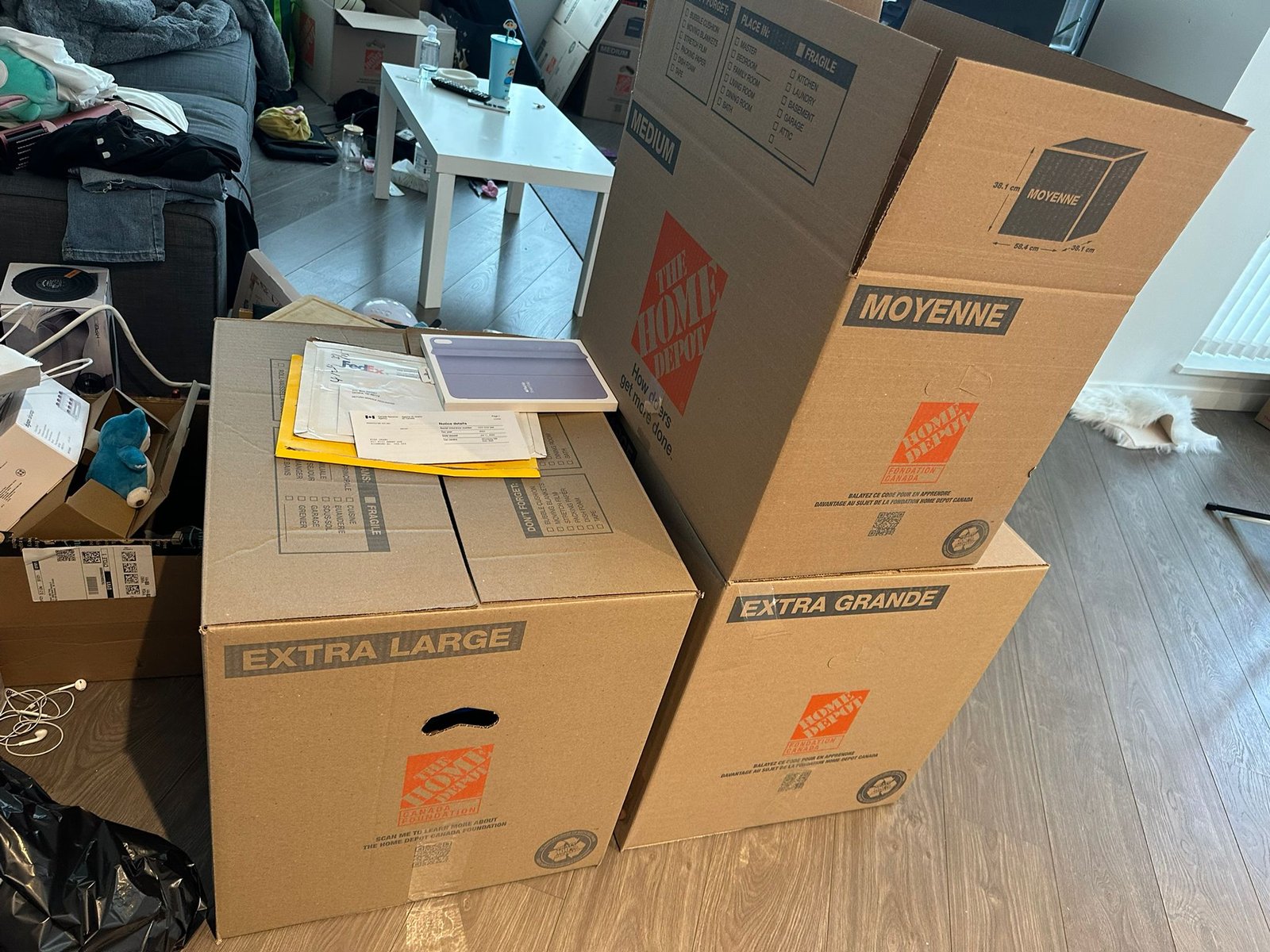
Here are the boxes we carry and what each one is built for. Sizes and weights are the standard moving-industry specs, so you know what fits before you order.
Small box (1.5 cu ft)
Sixteen by twelve by twelve inches, good for up to 65 pounds. This is your heavy box. Books, canned goods, tools, records, anything dense. Small on purpose so a full one is still liftable. A book box at twelve by twelve by twelve inches is the tighter version for a big library.
Medium box (3 cu ft)
Eighteen by eighteen by sixteen inches, up to 65 pounds. The everyday box that does most of the work: kitchenware, decor, linens, toys, office supplies. When people ask for "just regular boxes," this is the one.
Large box (4.5 cu ft)
Eighteen by eighteen by twenty-four inches, up to 65 pounds. For tall or bulky-but-not-heavy things: clothing, lamps, blankets. Keep the dense stuff out of it or it gets too heavy to carry safely up a walk-up stair.
Extra-large box (6 cu ft)
Twenty-four by eighteen by twenty-four inches, up to 65 pounds. Comforters, pillows, lampshades, winter coats. Light and puffy items that fill space without much weight.
Dish pack box (1.85 cu ft)
A double-walled box built for the kitchen: plates, bowls, glasses, mugs, cookware. Thicker walls take the knocks a normal box would not. Pack it with plenty of paper between every piece.
Wardrobe box (10 to 14 cu ft)
A tall box with a hanging bar inside, holding up to 100 pounds. Your closet moves straight across on the hangers, so nothing gets folded, crushed, or wrinkled. One of the best time-savers on move day.
How Many Boxes You Actually Need
A rough count so you order once, not three times. These are typical starting numbers for an average home, and a big kitchen or a serious book collection will push them up.
An apartment usually runs about 10 small, 10 medium, and 10 large boxes. A one or two-bedroom house is closer to 20 small, 20 medium, and 10 to 15 large. A three-bedroom-plus house lands around 25 small, 35 medium, and 15 to 25 large, plus a few wardrobe and dish boxes on top. Tell us your place and we will size the order for you instead of guessing.
Tape, Paper, Bubble Wrap and the Rest
Boxes are half of it. The materials that go inside and hold the box shut matter just as much, and running out mid-pack is the classic mistake.
Packing paper
Plain, unprinted, single-ply sheets for wrapping dishes, filling gaps, and separating stacked plates. Plan on about 200 sheets for a studio or one-bedroom, 500 for a multi-room home or a full dish collection, and 1,000 for a larger house or lots of fragile things. Paper is better than bubble wrap for most items because it takes less room, so you fit more per box.
Bubble wrap
Save this for the truly delicate stuff: electronics, screens, framed art, fine glass. A roll or two covers the fragile items in most homes. Use paper for everything else.
Packing tape
Figure about one roll of good tape for every 30 to 60 boxes. A one-bedroom move is usually 3 to 6 rolls, and a full house is 6 to 10 or more. Buy one extra. You will use it.
The extras
Wardrobe bars, mattress and sofa covers, stretch wrap for drawers, markers and labels for the room-by-room system. We stock these too, so the whole list comes from one place.
The Greener Choice: Reusable Plastic Bins
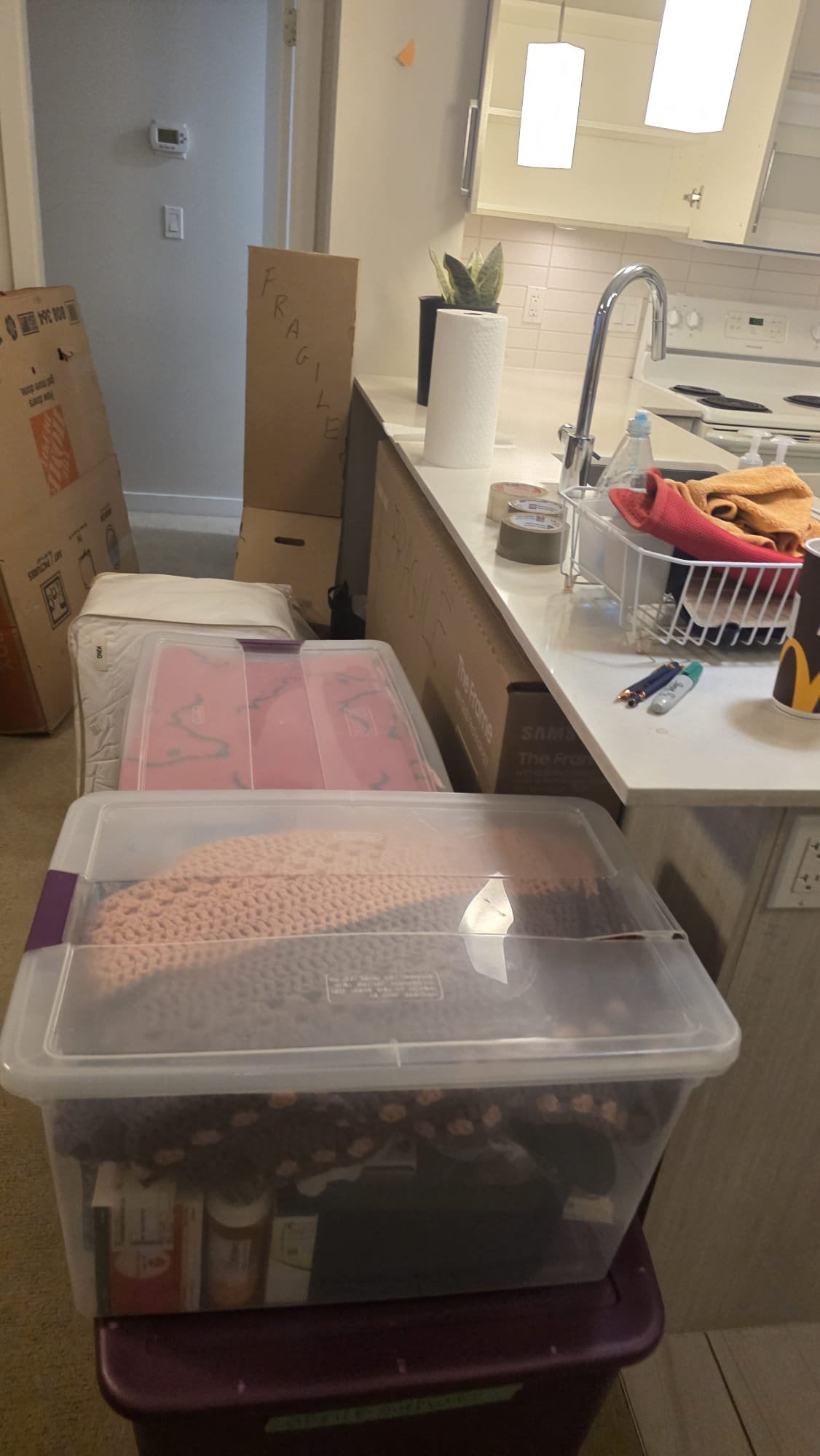
A lot of Vancouver movers now skip cardboard for reusable plastic bins, and it is worth knowing why. The bins get dropped at your door, you pack and move, and the company picks the empties back up. There is no flattening, no recycling run, and no pile of used cardboard in the alley when you are done.
The bins stack and nest, lock with a lid instead of tape, and hold up in the rain, which is a real plus in a Vancouver winter move. As a point of market context, local reusable-bin services report the plastic bins use around 40% less energy to recycle, create about 96% less solid waste, and result in roughly 25% fewer greenhouse gas emissions than cardboard over their life. Those are the reusable-bin companies' own figures, shared here so you can weigh the option. If you want the reusable route for your move, tell us and we will line up the bins and the timing with your packing days.
Delivery Across Vancouver
We bring supplies to you across the city: Downtown, Yaletown, the West End, Coal Harbour, Kitsilano, and Mount Pleasant, and out to the rest of the areas we serve. For a downtown tower, we time the drop to your building's rules so a cart of boxes is not sitting in a lobby that does not allow it. Order supplies on their own, or add them to your move and we arrive with them on packing day. Either way, you get the price for the supplies up front, same as the move.
How We Price Supplies
One straight story, no games. You get the price of every box, roll, and bin in writing before anything is delivered, so the supply cost is clear from the start. If you are booking a full move with us, the move itself is quoted up front in writing, with the crew, truck, and basic equipment included in the quote, and the supplies listed as their own line. We do not bury a guessed number over the phone and we do not spring a number on you at the tailgate. You see the whole thing before you say yes.
Why Vancouver Chooses Always Best Moving Vancouver
We size the order to your home
Tell us your place and your building and we set the right box mix, so you are not stuck with 20 empties or short by a dozen the night before.
Built around Vancouver buildings
A West End tower with a small service elevator, a Kits walk-up with a stair carry, a Yaletown loading dock. We pack and box for how your specific move actually loads.
One list, one crew
Boxes, paper, tape, bins, and the move all come from us, so there is one point of contact and one price sheet instead of five errands.
A 4.9-star record across 102 reviews
No marquee-client name-drops. Just a steady book of Vancouver moves and supply orders done right, with the price shown up front.
Moving Supplies Tips from Our Crew
Step 1
Order a week or two early, especially for a month-end or summer move, when boxes run short across the city.
Step 2
Put heavy things in small boxes and light things in big ones, so nothing is too heavy to carry up a walk-up stair.
Step 3
Keep every box under about 50 pounds, even if it can hold 65. Your back and your crew will thank you.
Step 4
Use a dish pack box for the kitchen and wrap each piece in paper. Do not stack plates flat, stand them on edge.
Step 5
Fill every gap with paper so nothing shifts. A half-empty box crushes when another one lands on it.
Step 6
Label the top and one side of each box with the room and a word or two on what is inside.
Step 7
Tape the bottom of every box in an H pattern across the seams, not a single strip.
Step 8
Pack a wardrobe box for hanging clothes and skip the folding entirely.
Step 9
Set aside one clearly marked "first night" box: chargers, meds, toiletries, a change of clothes, so you are not digging at 11 PM.
Frequently Asked Questions
Do you sell moving boxes on their own, or only with a move?
Both. You can order boxes and supplies from us with no move booked, and we will deliver them across Vancouver. If you are booking a move too, we can bring everything on packing day so it is one stop.
How many boxes do I need for my place?
As a rough guide, an apartment runs about 10 small, 10 medium, and 10 large. A one to two-bedroom is closer to 20 small, 20 medium, and 10 to 15 large. A three-bedroom-plus house is around 25 small, 35 medium, and 15 to 25 large, plus wardrobe and dish boxes. Tell us your home and we size it exactly.
What is a dish pack box and do I need one?
It is a double-walled box built for the kitchen: plates, bowls, glasses, and mugs. The thicker walls handle the bumps a normal box would not. If you are packing a real kitchen, yes, it is worth it, wrapped with plenty of paper.
Should I use packing paper or bubble wrap?
Paper for most things, because it wraps clean and takes up less room so you fit more per box. Save bubble wrap for the truly delicate stuff: electronics, screens, and framed art. Plan about 200 sheets of paper for a one-bedroom and up from there.
How much packing tape should I buy?
About one roll for every 30 to 60 boxes. A one-bedroom move is usually 3 to 6 rolls, and a full house is 6 to 10 or more. Buy one extra roll. It always gets used.
Are the reusable plastic bins better than cardboard?
They can be. The bins get delivered and picked up, so there is no cardboard to break down or recycle, and they hold up in the rain, which helps in a Vancouver winter. Reusable-bin services report big cuts in waste and emissions versus cardboard. Tell us if you want the bin route and we will set it up.
Can you deliver supplies to my downtown high-rise?
Yes. We time the drop to your building's rules so a cart of boxes is not left in a lobby that does not allow it, the same way we plan a full move around your elevator and dock. Just give us the building and your window.
How much will the supplies cost?
You get the price of every box, roll, and bin in writing before we deliver anything, so there are no surprises. If you are also booking a move, the move is quoted up front in writing and the supplies show as their own line.
Ready to book your move?
Real crews, real hours, full breakdown in writing before we start.
Downtown, Yaletown, West End, Coal Harbour, Kitsilano, Mount Pleasant (see Areas We Serve index)
Put These Supplies to Work
Other Moving Services
Downtown base, city-wide crews
422 Richards St, Vancouver, BC V6B 2Z4
236-885-7710 · Open 24 hours, 7 days
Ready to book your move?
Real crews, real hours, full breakdown in writing before we start.
236-885-7710